

Before starting Hot Aisle, I helped operate 150,000 AMD GPUs across seven data centers as part of one of the world’s largest Ethereum mining operations. When Ethereum moved from proof of work to proof of stake, the workload disappeared—but the experience left me with a clear understanding of what it takes to deploy, automate, and operate compute infrastructure at scale.
It also taught me something about technology cycles: demand rarely disappears completely. It changes shape.
That insight became the foundation for Hot Aisle.
The AI infrastructure market is optimizing for the wrong thing
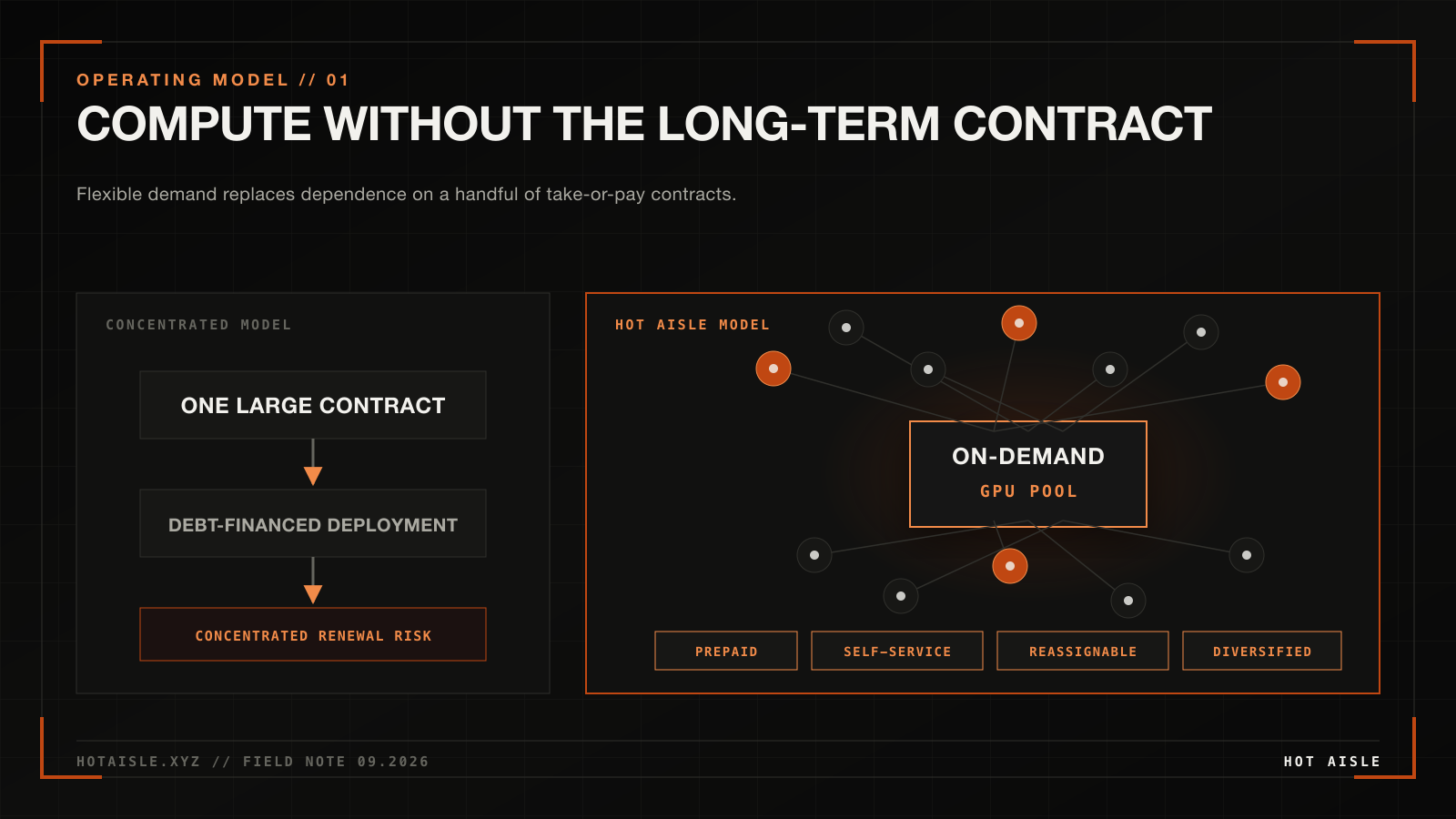
Most emerging AI clouds are following a familiar playbook. They secure a large, multi-year customer contract and then borrow against that contract to finance a major hardware deployment.
The arrangement is attractive to lenders because the customer has committed to paying for the capacity whether it uses it or not. For the cloud operator, however, the model creates several risks:
- Expensive debt remains even if customer demand changes.
- Revenue becomes concentrated among a small number of customers.
- Hardware and facilities must often be committed before the market has been proven.
- The operator becomes dependent on renewing a handful of very large contracts.
This model works while every customer wants more compute and capital is readily available. But technology markets move in cycles. AI adoption can continue growing even as individual companies fail, consolidate, reduce spending, or discover that they bought more capacity than they need.
When that happens, those companies will still need compute. What they may no longer want is a three-year, take-or-pay commitment.
Hot Aisle is being built for that market.
Compute without the long-term contract
Hot Aisle provides GPU compute on demand. A customer can create an account, fund it with a credit card, provision capacity, and start working without a sales process or a long-term contract.
Customers can use one GPU for a minute or operate substantial infrastructure over an extended period. They pay in advance, and the platform automatically tracks usage, billing, provisioning, and access.
That flexibility is valuable. Customers are willing to pay a higher hourly rate because they are not assuming years of financial risk. For Hot Aisle, the premium more than compensates for the small amount of capacity that may occasionally sit idle.
This is not merely a pricing strategy. It is a different operating model.
Instead of relying on one or two large customers to keep a deployment occupied, Hot Aisle serves hundreds of customers. Losing one workload does not threaten the entire business. Available capacity can immediately be reassigned to someone else.
Our existing deployment has operated at approximately 95 percent utilization and made Hot Aisle profitable—not simply on the basis of future contracted revenue, but as an operating business.
Automation is the real infrastructure
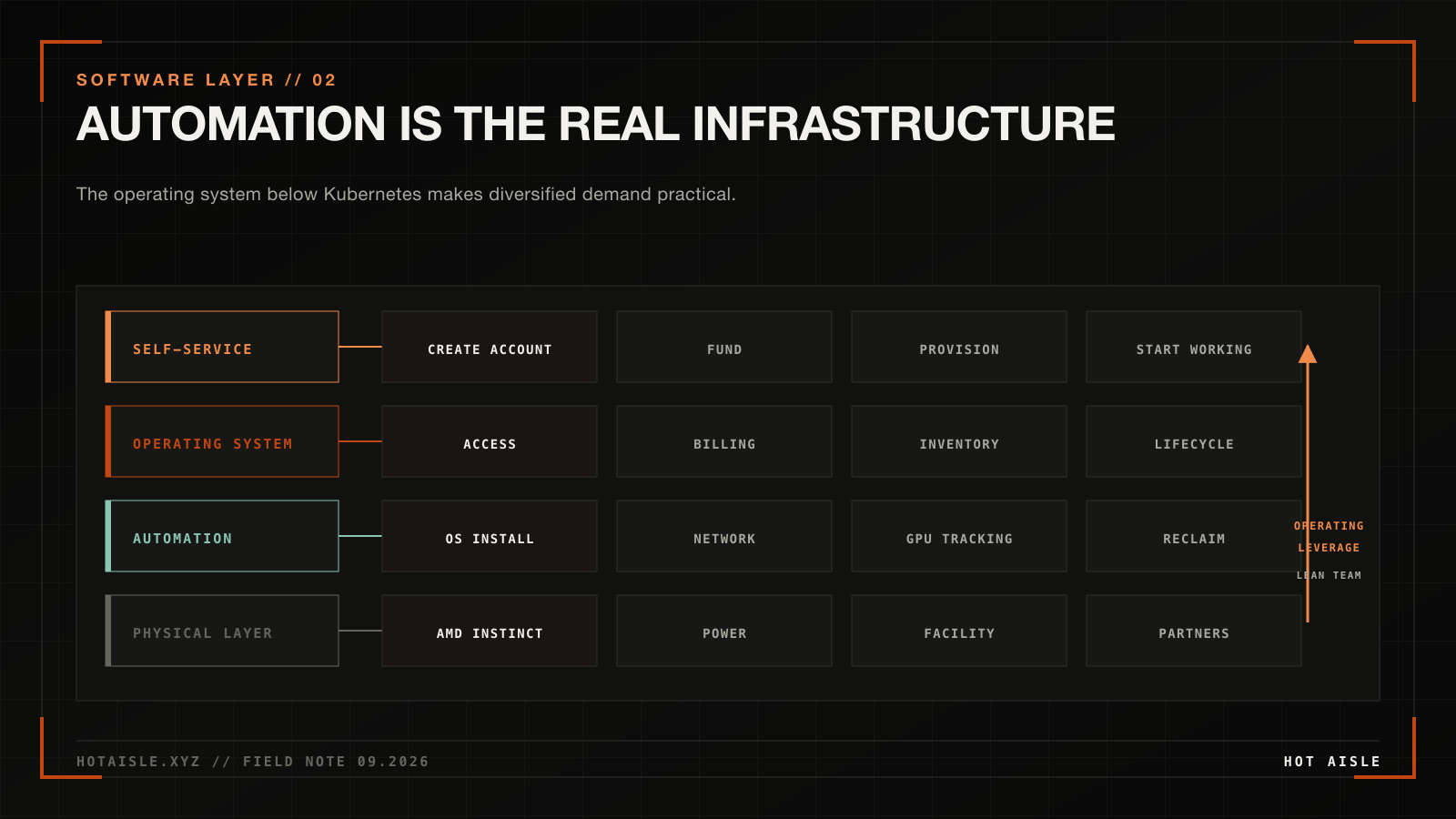
Serving hundreds or thousands of customers would be impractical if every deployment required an employee to configure servers, exchange credentials, calculate invoices, and reclaim capacity.
Over the past three years, we have built the software layer that makes the Hot Aisle model possible.
The platform automates the work below systems such as Kubernetes: installing operating systems, configuring networks, assigning addresses, managing access, tracking individual GPUs, collecting payments, producing billing records, and returning capacity to inventory when a customer is finished.
This software is not a separate product we intend to license. It is the operating system for the Hot Aisle business, in the same way that the internal software behind a hyperscale cloud exists to run that cloud.
The result is significant operating leverage. Hot Aisle can support far more customers and hardware without growing its team at the same rate. Hardware installation and maintenance can be handled with trusted infrastructure partners, while the customer experience remains almost entirely self-service.
Start small, prove demand, and repeat
The AI infrastructure industry is racing toward enormous campuses measured in hundreds of megawatts or even gigawatts. We believe there is another path.
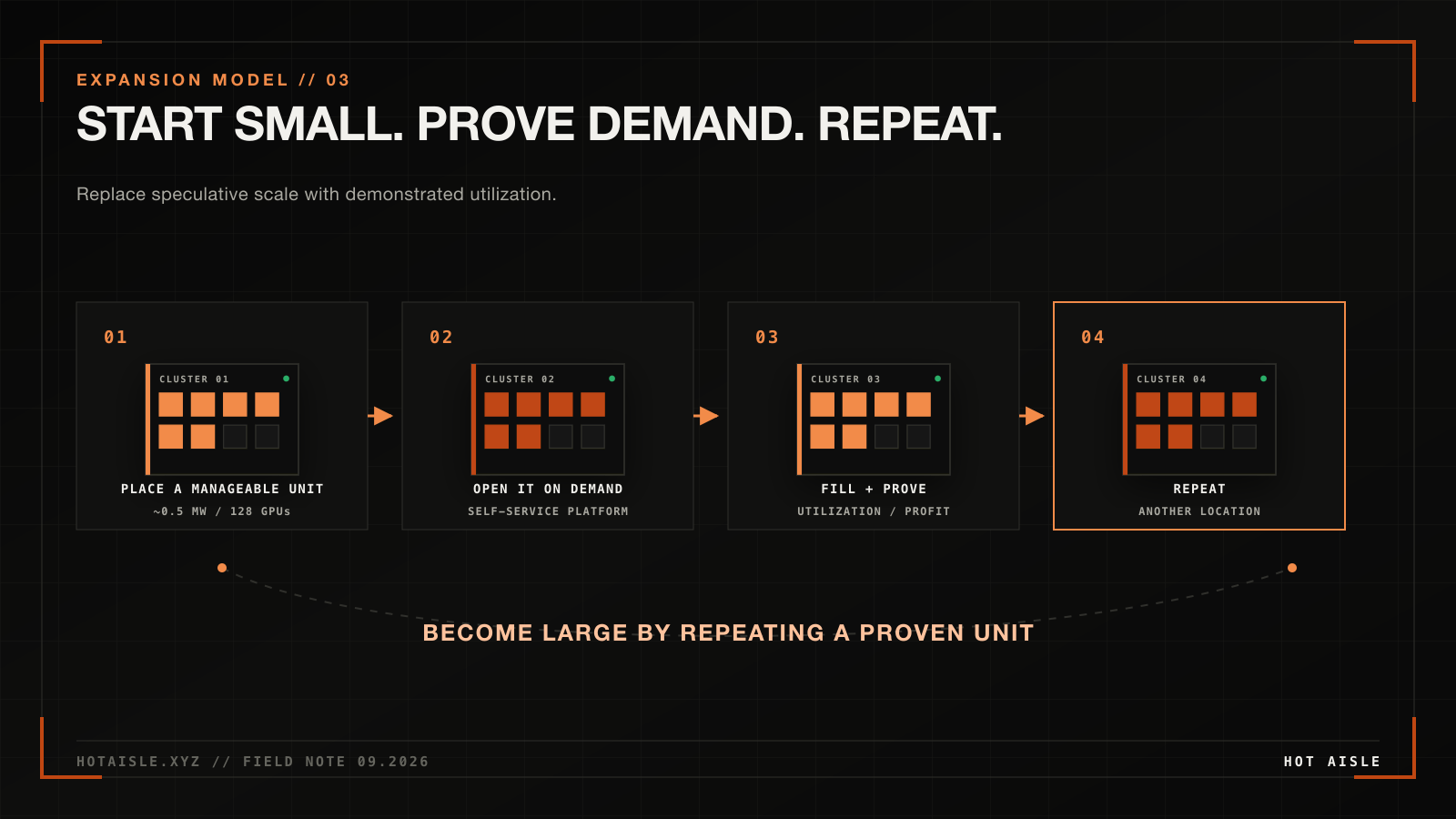
Hot Aisle’s expansion model begins with relatively small clusters—potentially around half a megawatt and 128 GPUs at a time. We deploy capacity where suitable power and data-center infrastructure are available, fill it with customer demand, demonstrate profitable operation, and then repeat the process.
This crawl-walk-run approach offers several advantages:
- It reduces the amount of capital exposed in any single deployment.
- It avoids waiting years for an enormous campus to be completed.
- It makes better use of smaller pockets of available power.
- It allows each location to respond to regional demand.
- It replaces speculative scale with demonstrated utilization.
The goal is not to remain small. The goal is to become large by repeating a proven unit of deployment instead of making one oversized bet.
Why AMD matters
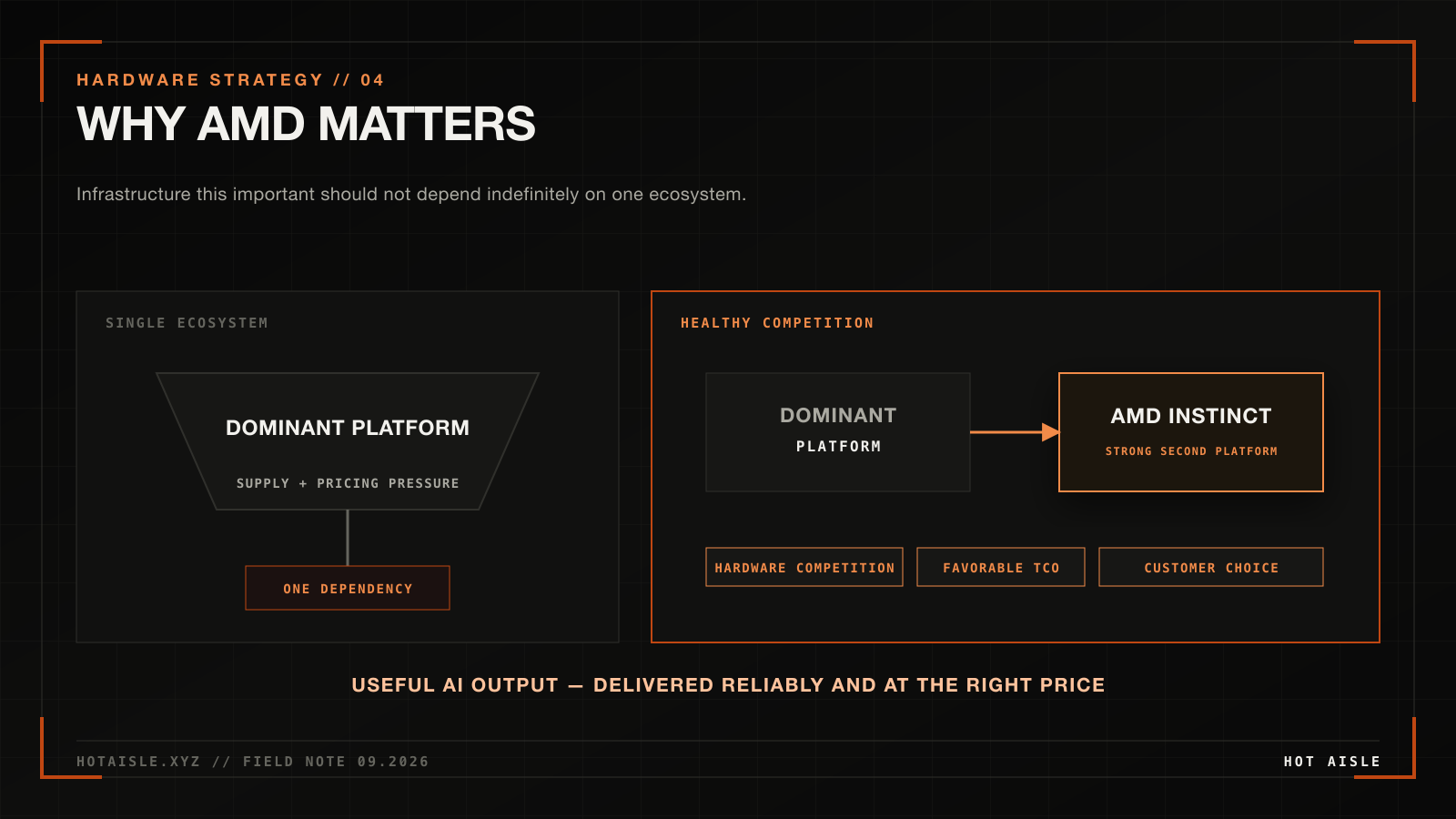
NVIDIA has built an extraordinary business and remains the dominant supplier of AI accelerators. But infrastructure as important as AI cannot depend indefinitely on a single hardware and software ecosystem.
There is usually room for a strong second platform: Windows and macOS, iOS and Android, Bitcoin and Ethereum. In AI infrastructure, we believe AMD can be that alternative.
Hot Aisle has deliberately developed deep experience with AMD Instinct hardware. AMD gives us an opportunity to acquire high-performance compute with a favorable total cost of ownership while avoiding some of the pricing and supply pressure surrounding the industry’s most heavily pursued hardware.
From the customer’s perspective, the brand printed on the accelerator is not the final product. The final product is useful AI output delivered reliably and at the right price. A token does not become more valuable because it was produced by one manufacturer rather than another.
A healthy AI ecosystem needs genuine hardware competition. Hot Aisle intends to help create it.
From one location to a distributed inference layer
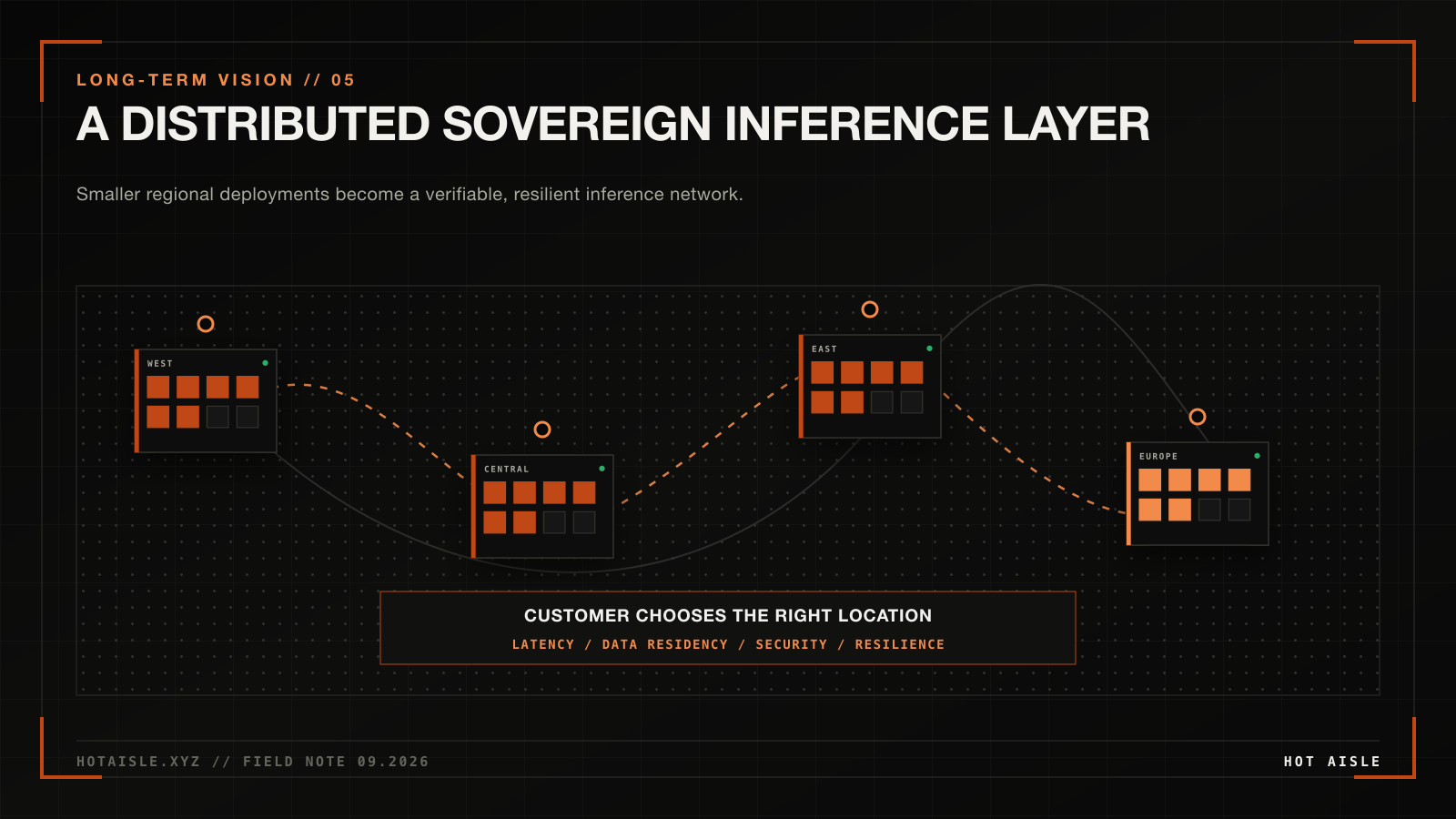
Today, Hot Aisle operates from one location. The long-term vision is a geographically distributed ecosystem of smaller compute deployments.
Think of the way internet infrastructure expanded: not through a single data center serving the entire world, but through capacity placed in many regions, closer to users and resilient to local disruptions. Hot Aisle wants to apply that principle to AI inference.
Over time, customers should be able to obtain compute in the locations that best fit their needs—whether those needs involve latency, data residency, regulatory requirements, security, or operational resilience.
This is what we mean by sovereign inference: organizations should have access to AI compute whose physical location, operators, and security boundaries can be understood and verified. They should not be forced to route every workload through a small number of distant hyperscale platforms.
The Hot Aisle platform provides the foundational compute layer. Customers remain free to deploy Kubernetes, redundancy, load balancing, and application-level orchestration according to their own requirements.
A different relationship with capital
The next stage of Hot Aisle requires capital, power, and suitable data-center space. But we want the financing structure to support the business model rather than distort it.
Instead of borrowing heavily against a small number of long-term customer contracts, we want to fund deployments primarily with aligned equity capital and flexible equipment programs. Hardware can then be refreshed on a predictable lifecycle as new generations become available.
The capital goes overwhelmingly toward productive infrastructure. Because provisioning, billing, financial reporting, and customer management are highly automated, the operating organization can remain lean.
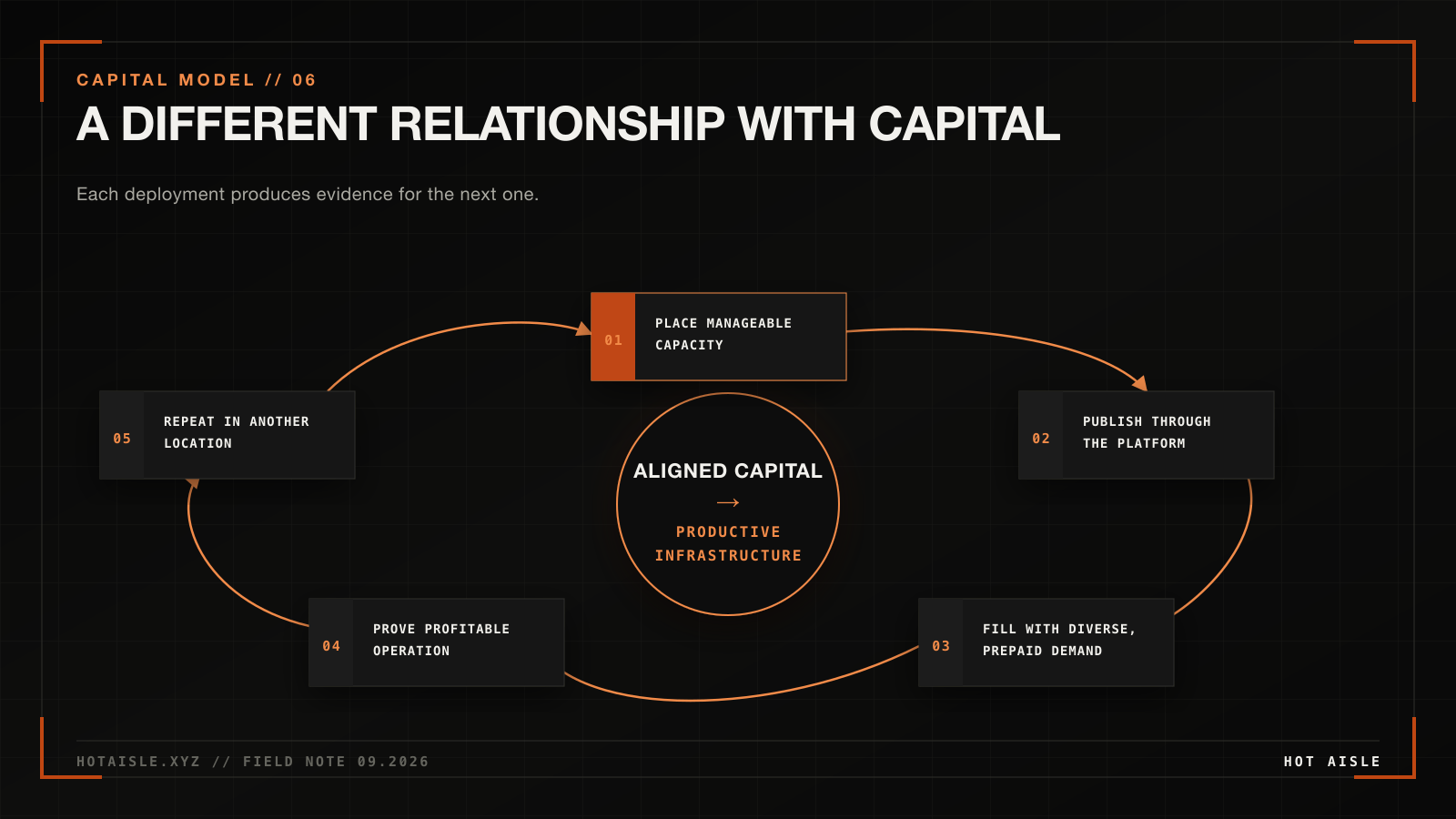
Each deployment should provide evidence for the next one:
- Place a manageable amount of capacity.
- Make it available through the Hot Aisle platform.
- Fill it with diversified, prepaid demand.
- Demonstrate profitable operation.
- Repeat in another location.
This is how we believe a durable AI cloud should be built.
The future we want to create
AI demand will keep growing, but that does not mean every AI company, financing structure, or capacity contract will survive unchanged.
The market needs an alternative for customers who want powerful infrastructure without surrendering flexibility. It needs an alternative hardware ecosystem. It needs capacity distributed across more operators, regions, and power markets. And it needs infrastructure companies built around sustainable unit economics rather than scale at any cost.
Hot Aisle has already built and proven the core operating platform. We have served hundreds of customers, automated the difficult parts of the customer lifecycle, and demonstrated demand for on-demand AMD compute.
What comes next is repetition: another cluster, another location, and then another.
Not one enormous speculative build, but a global inference layer assembled from profitable, resilient units—one hot aisle at a time.